
GPU module
The GPU module is a dynamically linked library that is loaded by the Screen resource manager only when hardware rendering is required (e.g., when an application makes an EGL or hardware rendering API call, or if the composition of the framebuffer has a dependency on the GPU stack). The Screen resource manager, as part of its boot optimization strategy, loads and starts drivers only when necessary, rather than at Screen's initialization time. The GPU module is one of these drivers that Screen starts on an as-needed basis.
The GPU module is configured with the gpu-dlls parameter under the
egl display section of the configuration file
(graphics.conf). Configuration of the GPU module is optional.
However, if there is a GPU on the target hardware, it's best to configure
gpu-dlls to optimize performance. If you configure the GPU
module, then Screen can use the GPU rather than the CPU. Also, if the configuration file
specifies a hardware blitter as the composition module (i.e., a hardware blitter is
configured in the blit-dll parameter of the egl
display section), then you must configure gpu-dlls.
Functionality
The GPU module is responsible for initializing the GPU stack, cleaning up, and exiting gracefully.
Interfaces
The GPU module needs to define functions specified in screen/gpu.h.
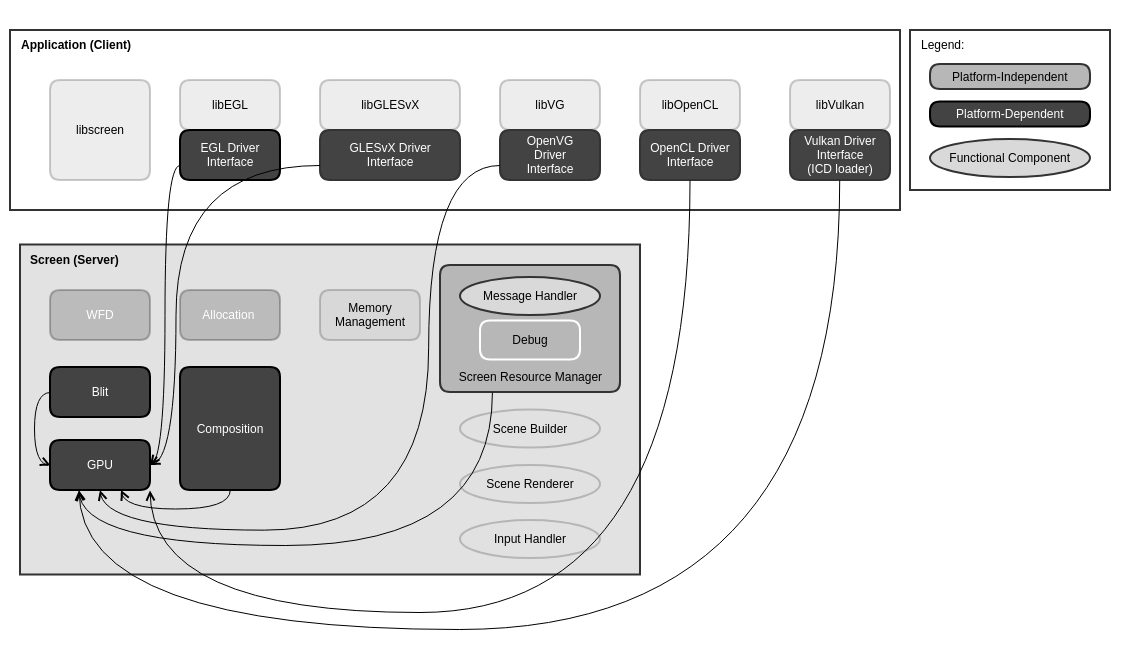
The following GPU module interactions are associated with the following graphics components:
| Module/Component | Interface | Description |
| Screen resource manager | Function call | The Screen resource manager accesses the GPU through these following interfaces:
|
| Blit | Function call | The blit module calls directly to the GPU through other interfaces provided by the GPU hardware. The interface between the blit module and GPU is platform-dependent. |
| Composition | Function call | The composition module calls directly to the GPU through other interfaces provided by the GPU hardware. The interface between the blit module and GPU is platform-dependent. |
| Driver Interfaces | Function call | These driver interfaces make calls directly to the GPU to support EGL and rendering functions. |
| Scene renderer | Function call | The scene renderer calls the GPU driver implementation that's platform-dependent: int (*init)(win_gpu_2_cm_iface_t
*iface)The argument for this initialization function is
defined
as:
|
Dependencies
The GPU module is how the Screen resource manager interfaces with the GPU stack. If other shared libraries are needed to run the GPU module correctly, they must be provided in the gpu-dlls parameter so all symbols can be resolved.
Error handling
If the initialization function of the GPU module returns anything else other than zero, this is considered a failure and the module is unloaded.
Memory Usage
Memory consideration for the GPU module is outside the scope of this documentation since it's platform-dependent.