Networking and Telecoms
- Whitepaper

- Software Optimization Techniques for Multi-Core Processors
- Foundry27
- BSPs and drivers
- Hardware support directory
- Ready to buy?
- Product delivery options
- We're here to help
While technology convergence translates into new revenue-generating opportunities for service providers and new functionality for consumers, it means additional complexity for network equipment manufacturers who already face staggering shifts in the marketplace: fixed-mobile convergence, IP multimedia subsystem, and 4G to name but a few.
Why customers choose QNX
We offer a comprehensive portfolio that addresses even the most complex development requirements across all networking systems – from optical networks through wireless infrastructure to the world’s highest capacity router.
Unlike companies offering open source solutions, we offer a hybrid software model and transparent development process where code is developed in the open. This unique approach coupled with our mature, field-proven support for multi-core processing and Linux API compatibility sets QNX Software Systems apart from all other embedded software vendors in the networking market. We also have the industry’s most extensive tool suite – award-winning, Eclipse-based, and optimized for rapid development.
- Technology — the most reliable and scalable runtime environment
- Ecosystem — silicon, protocols, tools, and middleware
- Services — from architectural and design reviews, through product development, to field trials and product deployment
Here's how you'll benefit
- Build carrier-class systems with maximum availability using the QNX high availability framework
- Achieve maximum performance by realizing the full potential of multi-core processors
- Lower your risk of vendor dependency with full access to source (including kernel) at Foundry27, the community portal for QNX software developers
- Reduce your time to market by using advanced tooling for rapid parallel development
- Leverage development skills and reuse software (including open source applications) across multiple products with standards-based technology and a modular architecture
Developing networking equipment is the single most complex task in the embedded market. Networking designs push the absolute limit of performance, reliability, and scalability. QNX Software Systems provides the most reliable and scalable RTOS, industry leading multi-core processor support, a high availability framework, and a comprehensive, Eclipse-based tool chain to ensure that your next design is successful.
The QNX networking software stack provides a complete solution for customers developing networking and telecoms equipment. Based on the ultra-reliable QNX® Neutrino® RTOS, it offers broad protocol support and middleware, and supports all key networking silicon architectures. What’s more, the QNX networking software stack readily scales from a SOHO gateway to a distributed multi-chassis system with hundreds of nodes.
 |
 |
 |
 |
 |
 |
The QNX networking software architecture stack provides a reusable base that can be used in a variety of applications.

Tools
Integrated development environment
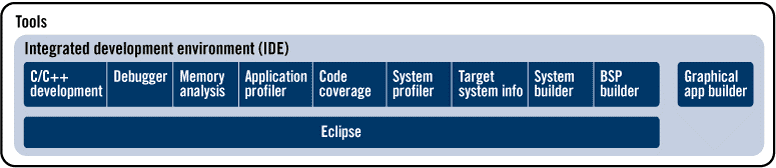
Built from the ground up to support multi-processing, the award-winning QNX® Momentics® Tool Suite is the industry’s most advanced IDE for realtime development. It offers a full spectrum of tools for developing, debugging, and optimizing code, and is equally at home in uni-core and multi-core environments.
For multi-core based development, the QNX Momentics Tool Suite provides an application profiler to identify opportunities for parallelism and a unique system profiler for white box visibility into thread-level timing and inter-process communication.
See also: QNX Momentics Tool Suite, QNX Neutrino RTOS Multi-core
Management/ Middleware
Provided by QNX Software Systems and a growing ecosystem, this layer provides key services including Simple Network Management Protocol (SNMP), service availability forum HA, Corba, and web services.
Protocols
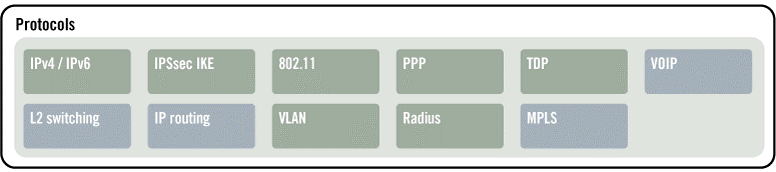
QNX Software Systems provides a number of natively supported networking protocols based on standard industry implementations. Stacks are pre-integrated and fully tested with the QNX Neutrino RTOS for reduced development time and accelerated product delivery. In addition, many third party protocol vendors also provide pre-integrated offerings including VOIP, IP routing, and more.
See also: QNX Neutrino RTOS Networking
OS services
Filesystems
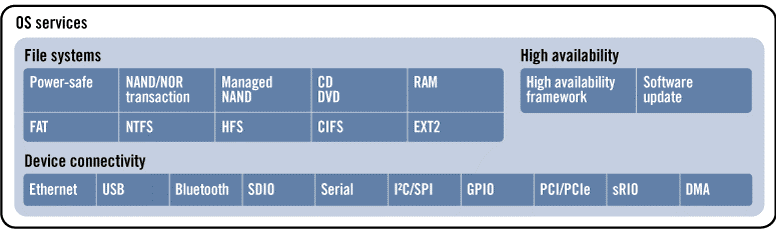
QNX Software Systems supports a wide range of block and flash filesystem formats. Networking developers value the reliability and security of our power-safe disk filesystem for guaranteed data integrity even in the most demanding environments. Our NOR and NAND flash filesystems provide enhanced features such as a standard POSIX interface, fault tolerance to power failures, and wear levelling for extended part lifetime.
See also: QNX Neutrino RTOS Filesystems
High availability
No market imposes more stringent requirements for availability than networking and no realtime OS offers more in terms of reliability than the QNX Neutrino RTOS. To further increase availability, QNX Software Systems offers a high availability framework. Using this framework, developers can devise fault recovery scenarios that can execute without a system reboot.
See also: QNX Neutrino RTOS High availability
Core OS
Core operating system
The QNX Neutrino RTOS is designed specifically to meet the most demanding reliability and performance requirements. The microkernel architecture incorporates only core functionality into a tiny, well-tested kernel, while leaving drivers, networking stacks, and other services outside in memory-protected space. This creates the ideal foundation for 99.999% reliability.
See also: QNX Neutrino RTOS
Security
To address the ever-increasing security threats facing embedded systems, whether they are large distributed systems or small isolated industrial controllers, QNX has advanced security mechanisms that are built directly into the QNX Neutrino RTOS that protect the device from malicious attacks. These can be used to ensure that all processes, including drivers and filesystems, execute in user-mode, greatly reducing the ability of compromised processes. Further, it is possible to divide the filesystem into encrypted domains, as well as to randomize the address space layout for further protection against malicious intent.
The security attack surface of the system can be further reduced by utilizing a unique ability to control settings that govern and protect which operations a process can perform, with granularity down to the system-call level. As a result, embedded developers no longer have to give processes root permissions and access to the entire system in order to gain access to necessary system resources.
Multi-core
Driven by the need for maximum processing power in high-end networking equipment, QNX Software Systems has supported discrete implementations of multiprocessing for over a decade. QNX multi-core technology ships today in many production programs and has been hardened by use in the most demanding applications. Likewise, the QNX Momentics Tool Suite was developed from the ground up with multiprocessing in mind. It's the most sophisticated multi-core development environment available today.
See also: QNX Multi-core Technology
Adaptive partitioning
QNX adaptive partitioning technology is a unique approach that provides CPU resource guarantees to defined partitions, ensuring all system elements have access to critical resources. However, unlike fixed partitioning, it allows partitions to exceed minimum time budgets if spare processing cycles are available. This allows a system to maximize CPU time while ensuring high availability – containing DoS attacks, preventing runaway command-line interfaces, and so on.
See also: QNX Neutrino RTOS Adaptive Partitioning
QNX Software Systems provides a comprehensive suite of natively supported networking protocols based on standard industry implementations. Stacks are pre-integrated and fully tested with the QNX® Neutrino® RTOS, allowing developers to reduce development time and accelerate product delivery.
With the QNX Neutrino RTOS, networking protocols execute outside the kernel as separate, memory-protected processes. As a result, developers can combine any number of natively supported networking protocols, including TCP/IP and transparent distributed processing. They can also run multiple applications, such as virtual routing, using a single protocol stack on a single physical box to add incremental security or management for specific applications.
Highlights
- Pre-integration with the QNX Neutrino RTOS to get development teams up and running quickly
- Additional source code modules for hardware integration and optimization
- Standard BSD reference implementations and support for current industry standards
- Support for both IPv4 and IPv6 with a full migration path from IPv4 to IPv6
- Third-party networking code based on POSIX and BSD APIs
End user demands continue to drive the need for maximum processing power. Silicon vendors, unable to scale exclusively with clock speed, have moved to a multi-core architecture to increase overall performance. While this solves the overall MIPs problem, it introduces a new level of complexity for the networking software developer.
QNX Software Systems is the only RTOS vendor to provide a comprehensive multi-core offering. In fact, QNX has supported discrete implementations of multi-processing for over a decade. This multi-core technology ships today in many production programs and has been hardened by use in the most demanding applications.
The QNX® Neutrino® RTOS offers three multi-core modes of operation:
- Asymmetric multiprocessing (AMP) – run the QNX Neutrino RTOS on each core using QNX transparent distributed processing as an inter-process communication mechanism or use Transparent Inter-Process Communication (TIPC) to communicate between QNX and Linux cores
- Symmetric multiprocessing (SMP) – run a single instance of the QNX Neutrino RTOS to manage thread scheduling and shared resources
- Bound multiprocessing (BMP) – run specific processes tied to individual cores with a single instance of the QNX Neutrino RTOS to manage shared resources
Developers can choose to let some processes run in SMP mode while using BMP to migrate legacy code.
Multi-core tools
QNX Software Systems understands that tools play a critical role in debugging and optimizing complex networking applications. That’s why the QNX® Momentics® Tool Suite was built from the ground up to support multiprocessing. It is, in fact, the only fully multi-core-aware tool suite available today. It offers highly advanced visualization tools such as application and system profilers, which allow developers to indentify code that can benefit from multi-core processing and to get a thread-level view of system performance.
See also: QNX Neutrino RTOS Multi-core
Networking developers want the self-sufficiency and code access that comes with an open source model, but they also understand the benefits of a commercially supported offering - quality product management, published roadmaps, IP protection, and professional support.
QNX Software Systems understands this dichotomy and has created a new hybrid software model that combines the best of both worlds, providing the flexibility of the open source model with the benefits of a commercially supported solution. Highlights include:
- Availability of all QNX source code at no charge
- Professional support and access to QNX engineers who write QNX code
- Simplified engagement model for prototyping phase of project development
- Clean intellectual property and non-viral licensing model
- Community environment at Foundry27
QNX Software Systems has a broad and growing partner ecosystem of established and emerging companies that share our long-term commitment to providing best-of-breed solutions. Coupled with the QNX networking stack, these solutions help our networking customers build high-performance carrier-class systems faster, at lower cost, and more reliably.
Semiconductor
Board vendors
|
Protocols, middleware and tools
SNMP
|
QNX Professional Services is a committed group of engineers with extensive experience optimizing systems for multi-core processing, migrating code from Linux platforms, and supporting custom networking boards. This group understands the importance of avoiding product downtime, keeping up with the latest hardware advancements, and leveraging investments in core IP - and takes great pride in sharing their expertise.
Along with an extensive support and professional services offering, QNX Professional Services helps networking customers in the following ways.
Optimizing Systems for Multi-core Processing
Parallelism is an important design consideration for the networking industry where performance-hungry, compute-intensive applications require parallel software that uses multiple cores simultaneously. QNX Software Systems has been supporting symmetric multi-processing (SMP) since 1997. The professional services team of developers, engineers, and architects can help dramatically improve system performance using multi-core optimization techniques and visualization tools.
Porting from Linux
Network equipment manufacturers are increasingly interested in the benefits of realtime computing for achieving 99.999% reliability. Customers porting Linux applications to the QNX® Neutrino® RTOS find it surprisingly straightforward (since both use the POSIX API), however they also find porting low-level Linux drivers (to any OS) to be a bit more challenging. QNX Professional Services keeps a smooth migration path while ensuring ported applications are fast, reliable, and maintainable.
Custom Hardware Support
QNX software engineers are seasoned experts in developing optimized QNX-compatible drivers and board support packages (BSPs) for networking-centric platforms. They use their extensive experience with leading-edge networking hardware (like the Freescale QorIQ platform and Cavium Networks OCTEON family) to ensure software integration is optimal and maintainable for current and future deployments.
See also: Support, Professional Services, Training and Education,, Consulting and Programs
  Website Website
|
AdtranWhen Adtran went looking for a successor to their in-house OS, they selected the QNX® Neutrino® RTOS for its highly available architecture, comprehensive development suite and the ability to scale across their entire product line. |
 Website Website |
Ciena NetworksTired of complex debugging in the VxWorks environment, Ciena switched to the QNX Neutrino RTOS for their CN 1000 Broadband Loop Carrier Next Generation Access Platform. QNX architecture enabled developers at Ciena to rapidly isolate issues and greatly accelerate the debugging of their systems. |
 | Cisco SystemsWhen Cisco wanted to start developing their next generation software platform, they turned to QNX Software Systems. Today the QNX Neutrino RTOS is at the heart of Cisco’s Modular IOS and IOS-XR software, and powers many Cisco products including the Cisco CRS-1, the world’s highest capacity router. |
 Website Website |
DragonWaveAbsolute reliability and world class support drove DragonWave to choose QNX technology for the Horizon Duo, their next generation carrier-grade microwave product. |
 Website Website
|
InfineraWhen Infinera was architecting the Infinera DTN, the world's first switched WDM digital ROADM system, they quickly realized that their design would need a highly scalable architecture. They chose the QNX Neutrino RTOS for its ability to support and debug a design with upwards of 1000 threads. |
 Website Website |
JDSUThe JDSU WaveReady product line is a scalable Wavelength Division Multiplexing (WDM) optical transport solution designed for metro, access, and enterprise optical networks. JDSU selected the QNX Neutrino RTOS for its high availability and reliability, key attributes of the market JDSU serves. |
 Website Website |
BTI PhotonicsBTI Photonics needed to jump start their development in advance of hardware availability. They selected the QNX Neutrino RTOS over Linux for their BTI 7000 optical repeaters due to its high availability and ability to prototype on desktop machines. In addition, the modular nature of the QNX architecture enabled them to dramatically decrease their time to market. |
 Website Website
|
StokeWhen selecting an OS for the SSX-3000 mobile broadband access gateway, Stoke wanted clean IP and access to kernel source. Linux and the GNU Public License were not an option; the QNX hybrid software model fit the bill. |