
QNX SDP 8.0.5 Release Notes
QNX SDP is a cross-compiling and debugging environment, including an IDE and command-line tools, for building binary images and programs for target boards running the QNX OS 8.0.5. These release notes describe the key features of this new release and the notable improvements since the previous release, and provide installation instructions.
Date of this edition: June 25, 2026
Target hardware
This product can run on x86_64 hardware platforms and AArch64 platforms that support the ARM 64-bit (A64) Instruction Set.
Development Host Operating Systems (OSs)
You must install QNX SDP 8.0.5 onto a development host with one of the following 64-bit operating systems:
- Microsoft Windows 11
- Ubuntu Desktop 24.04 LTS, Ubuntu Desktop 22.04 LTS, or Red Hat Enterprise Linux 9
Contents
What's new in QNX SDP?
| Component | Feature | Details |
|---|---|---|
| Kernel | Configuration of number of channels for message handling | The new procnto option -w allows you to specify the number of channels over which it handles messages from user processes. |
| Kernel | CPU On/Off Lining | Improvements and bug fixes have been made related to offlining/onlining CPUs at runtime. |
| Kernel | Process Introspection API | The new introspection API (IAPI) allows the collection of system information and process inspection without using the /proc filesystem. |
| Kernel | SSBS (Speculative Store Bypass Safe) | SSBS (Speculative Store Bypass Safe) is a processor state flag that disables speculative store bypass to mitigate certain speculative execution vulnerabilities. |
| Kernel | Container Kernel Changes | Kernel changes have been introduced to support QNX Containers, providing the underlying mechanisms required for container isolation, resource management, and execution. |
| Kernel | In-kernel Pipes | In-kernel pipes have been introduced as a kernel-level data transfer mechanism for efficient communication within the kernel. They support extended message types and configurable I/O behavior, while maintaining compatibility with existing POSIX pipe functionality. |
| Kernel | Spectre v2 Mitigation | Spectre v2 mitigation introduces hardware and software protections to prevent speculative execution attacks from exposing sensitive data. |
| Kernel | Deferred System RAM | Deferred System RAM (_MEM_PMEM_ADD) now allows the system to add physical memory to the kernel’s usable pool after boot. |
| Kernel | Configurable system wide default thread stack size | The new procnto option -s allows you to set a system-wide default stack size (in bytes) for regular user threads, including SIGEV_THREAD threads. |
| Networking | Marvell Network PHY | The devs-marvell_phy.so driver is released as stable. |
| Networking | FreeBSD version update | The FreeBSD version that QNX OS networking is based on has been updated from 13.5 to 14.3. |
| Networking | High-performance networking stack | New sysctl tunables:
|
| Security |
Security Events |
A new function secpolev_get_timestamp() returns the original timestamp of the current security event. |
| Filesystems | Power-Safe (QNX 6) filesystem | The Power-Safe (QNX 6) filesystem now allows you to enable trimming on very short-lived files. Trimming entails informing the underlying device that certain sectors are not needed and therefore can be discarded. This feature can help maintain write performance. |
| Filesystems | Power-Safe (QNX 6) filesystem | The Power-Safe (QNX 6) filesystem has a new feature: defragmentation. When a regular file is opened, the defragmentation service combines smaller blocks into larger blocks to keep I/O performance optimal over time. This feature is configured through a new fs-qnx6.so option, defrag. |
| Filesystems | Support for inotify() | Added support for ionotify() in the fsevmgr client interface, allowing clients to receive event notifications using standard I/O notification mechanisms, such as poll(). |
| Filesystems | Support for numocb= option | Support has been added for the numocb= option, which can be used with allocation modes such as alloc=upfront and alloc=greedy. |
| Utilities | GDBServer | This package contains GNU Project Debugger Server for QNX OS hosts. |
| Utilities | CPU offlining | CPU offlining disables a CPU core so that it is no longer used for scheduling or visible as active to user-space tools. |
| Utilities | Introspection | The Process Introspection API provides controlled access to information about processes, threads, memory, and system state for debugging, monitoring, and diagnostics. |
| OS Libraries | JSON encoder | The JSON library, libjson, now provides json_encoder_add_int_ull(), json_decoder_get_int_ull(), and json_decoder_is_unsigned(), which allow applications to encode, decode, and check for 64-bit unsigned integers. |
| OS Services | PLMS | The QNX® SDP 8.0 QNX Process Launcher and Monitor Service (PLMS) has been introduced as a process launching and monitoring service that manages system components based on a configuration file. It provides support for starting, stopping, and restarting components, monitoring their state, and handling dependencies between them. |
| Screen | VulkanSC | The Vulkan ICD loader has been updated to version 1.4x. |
| Screen | Debug Overlay | Added a visual debugging layer that overlays content and displays
diagnostic information to help analyze rendering and troubleshoot
issues. For more information, refer to Screenbelow. |
| Screen | Updates to image codec | The following updates have been made to the image codec:
|
| Screen | Screen driver DDK | The new QNX® SDP 8.0 Screen Driver Development Kit includes header files and static libraries, which provides the tools required to develop QNX Screen display and GPU drivers. |
| Screen | Virtual display | The virtual display can now be configured without a framebuffer/compositor, or framebuffer class. |
| BSP Frameworks | Input component | The input component was updated for enhanced functionality. |
| BSP Frameworks | New GPIO framework | A new hardware-agnostic GPIO framework has been added. |
| BSP Frameworks | Separate package for common PCI HW module source | The common PCI HW module source has been moved into a new library,
libpci_hw_common. |
| BSP Frameworks | PCIe Gen4, Gen5 support | Added official support for PCI Gen4 and Gen5 link speeds. |
Screen
Debugging information is now available above the content; this visual debugging overlay
displays useful diagnostic and debug information: 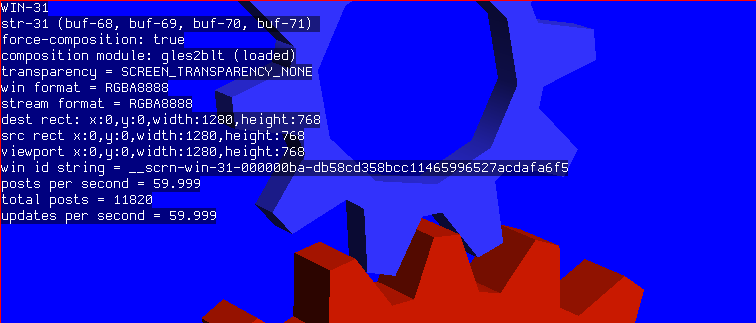
Screen demonstrator applications (such as gles2-gears and
vk-gears) are now optional and are not installed by default. To
install these demos, install the com.qnx.qnx800.target.screen.demos
package.
Installing QNX SDP
To use QNX SDP 8.0.5, you need to have QNX Software Center 2.0.4 or later. For
information about installing and opening this other product, refer to the Install and launch the QNX Software Center
chapter in the QNX
Software Center User's Guide.
You install QNX SDP 8.0.5 as a new baseline product by installing QNX SDP 8.0.5 with the conservative installation policy selected. Currently, you cannot update an existing QNX SDP 8.0.x installation to QNX SDP 8.0.5 using a patch set.
To install the QNX SDP 8.0.5 product:
- Open the QNX Software Center and click Add Installation.
- In the New Installation Wizard, expand QNX Software Development Platform 8.0, select QNX Software Development Platform 8.0, and then click Next as needed to navigate to the Installation Properties page.
- In the Installation Properties page, for Update Policy, select Conservative, and then complete the rest of the installation steps.
For more information, go to the Install the QNX Software Development Platform
chapter in the QNX
Software Center User's Guide.
To access the contents of the package, right-click QNX OS and QNX Tool Suite, choose Properties, then click Package Contents. Some of the packages may contain no files but instead references to contained packages (or subpackages), in which case the contents page display a note saying so. To access the list of subpackages, right-click the package, choose Properties, then click Package Dependencies. Because the baseline OS product has many inter-package dependencies, sometimes you have to go through multiple levels of subpackages to access the included files.
You can also obtain the maturity statuses of files by generating a manifest
report. For more information, refer to the Manifest Reports & File Lookup
chapter of the QNX Software
Center User's Guide.
Each package has its maturity level. You can learn
this by right-clicking the package, choosing Properties, then
clicking General Information. In the Legal and
Regulatory Information panel, there's a Status
field. For details about the possible values of this field, refer to Package
status
in the Deploy licenses to users
section in the QNX Software Center User's
Guide.
Debug information for shipped binaries
The QNX SDP target binaries are generated with debug information (-g), with the debug form of the binary stored in a separate binaryName.sym file. The non-sym form is stripped of the debug and .ident information (use -s works only on files containing the .ident section).
Most target packages include debug information (.sym files). The binaries and their .sym files are linked, so gdb understands where to find the symbol data. There's no need to store .sym files for the binaries on a target.
If the debug symbols are especially large, there might be a separate debug package in the QNX Software Center. To install debug symbols in this case, select your installation from the toolbar, then go to the Advanced tab. Click Edit Installation Properties. In the property dialog that opens, ensure that the Install debug symbols checkbox is selected (this box is selected by default). Click OK.
If you decide to not install the debug information but later want it, you can right-click a package and choose Install debug symbols.
Discontinued and deprecated items
For documentation on all items that are no longer shipped in this release or will be removed in a future release, refer to the QNX Software Development Platform 8.0: Discontinuation and Deprecation Notice.
Experimental items
Some experimental items are implemented in the packages of the baseline product. This means these items are installed when you install QNX SDP and, hence, there's nothing else you must do to be able to use them. Other experimental items are contained in their own packages that aren't installed when you install QNX SDP. To locate and install these packages so you can use the items they contain, go to the Available tab in QNX Software Center and search for part or all of the package name. Then, click the package in the search results and then the Install button in the bottom right corner.
The table that follows lists the experimental items by functional area and indicates whether each one is contained in an additional package that must be installed separately.
| Functional area | Item description | Additional package |
|---|---|---|
| BSP & Drivers | Added Dynamic Interrupt Manager (DIM) | None |
| Networking | Texas Instruments Jacinto 7 network drivers (devs-cpsw-j721e.so, devs-cpsw-j784s4.so, devs-cpsw-j721s2.so) | None |
| Networking | Texas Instruments Sitara network driver (devs-cpsw-am62x.so) | None |
| Networking | RT9010 network PHY driver (devs-rt9010phy.so) | None |
| Networking | DWC gmac network driver (devs-dwc.so) | N/A |
| Networking | RNDIS USB network driver (devs-urndis.so) | N/A |
| Networking | DPA drivers for io-sock (dpaa2) | N/A |
| Filesystems | QNX Filesystem for Safety Device Driver | |
| Utilities | This package contains GNU Project Debugger Server for QNX OS hosts. | N/A |
| Screen | Support for the core Wayland communication library and the Weston compositor for Screen | QNX SDP 8.0 Wayland/Weston |
| Screen | Tools for using Wayland on Linux 64-bit hosts | QNX SDP 8.0 Wayland host tools (Linux 64-bit) |
| Screen | Tools for using Wayland on Windows 64-bit hosts | QNX SDP 8.0 Wayland host tools (Windows 64-bit) |
| Screen | OpenWF Display Server | QNX SDP 8.0 Screen WFD Server |
| Screen | Base Graphics | QNX SDP 8.0 Screen Base Graphics Source Code |
| Screen | Demos and Tutorials | QNX SDP 8.0 Screen Demos and Tutorials Source Code |
| Screen | Demo and Sample applications | QNX® SDP 8.0 Screen Graphics Demo/Sample Applications |
Fixed issues
| Description | Applicable Architecture(s) | Application-Level Impact | System-Level Impact | Reference Number |
|---|---|---|---|---|
When configured to use a state file,
secpolgenerate incorrectly reported all abilities defined in
the original policy as used, even if they were unused. This issue has been fixed
so that only abilities actually exercised are reported. |
General | Not available. | Not available. | 3006411 |
The secpolgenerate tool no
longer applies special handling to the priority:255 value,
ensuring consistent and predictable behavior when generating security
policies. |
General | Not available. | Not available. | 3001100 |
The secpolgenerate tool could
terminate with a SIGSEGV when processing a state file
containing a mem_phys ability without an associated range. This
issue has been fixed to prevent crashes when such input is encountered. |
General | Not available. | Not available. | 3006206 |
The secpolpush tool no longer
fails when procmgr_ability_create() returns an error,
allowing policy updates to proceed without interruption. |
General | Not available. | Not available. | 3001750 |
The secpolgenerate tool
incorrectly handled errors returned by
procmgr_ability_create(), resulting in improper error
checking during policy generation. This issue has been fixed to ensure errors
are correctly detected and handled. |
General | Not available. | Not available. | 3006701 |
The secpolgenerate tool could
create new types when running in monitoring mode, resulting in unintended policy
changes. This issue has been fixed to prevent the creation of new types during
monitoring. |
General | Not available. | Not available. | 2991964 |
Fixed an issue where the
libsecpolev library could experience buffer overruns and
other memory-handling problems, potentially leading to instability or incorrect
behavior. |
General | Not available. | Not available. | 3020882 |
Fixed an issue where the
secpolgenerate tool could crash when processing a
configuration file containing unexpected or extra types. |
General | Not available. | Not available. | 3015878 |
Fixed an issue where
secpol-preload could exceed the maximum mount point handle
limit, potentially preventing proper handling of mount points. |
General | Not available. | Not available. | 2976235 |
Fixed an issue where secpol
utilities could block when processing empty ability ranges. |
General | Not available. | Not available. | 2984018 |
Fixed an issue where the
LC_ALL and LANG environment variables were
not set by default, which could lead to inconsistent locale behavior in
applications. |
General | Not available. | Not available. | 3017834 |
| Fixed an issue where AddressSanitizer and Leak Sanitizer did not work correctly when Address Space Layout Randomization (ASLR) was enabled, which could cause instrumented applications to fail or produce incorrect results. | General | Not available. | Not available. | 3014985 |
Fixed an issue where
LeakSanitizer and AddressSanitizer did not
work as expected, which could result in incomplete detection of memory leaks and
memory errors in instrumented applications. |
General | Not available. | Not available. | 3002502 |
Fixed an issue where gdb
could fail to interrupt a running process, preventing users from pausing
execution during debugging. |
Aarch64, Host-Windows | Not available. | Not available. | 3000560 |
Fixed an issue where the
mkqnx6fsimg utility used an incorrect default value for
num_sectors, which could result in improperly sized
filesystem images. |
General | Not available. | Not available. | 2981646 |
Fixed an issue where fsevmgr
could crash when inotify_rm_watch() was called and the
associated filesystem was subsequently unmounted. |
General | The fsevmgr process could
terminate with a SIGSEGV, rendering all inotify watches
inoperative. |
The fsevmgr and
libfsnotify.so binaries must be updated. These binaries are
typically located in the primary boot IFS. |
3021215 |
Fixed an issue where io-blk
could crash when using on-demand cache allocation mode. |
General | A devb process would terminate at startup if run with "alloc=demand", or the size of "cache=" was too big to be fully allocated. | The fix is within io-blk.so. If this binary is included in the primary boot IFS, then the primary boot IFS will need to be re-built. | 3021620 |
Fixed an issue where fsnotify
did not handle filesystem unmount operations correctly, which could lead to
inconsistent notification behavior for file system events. |
General | Events triggered immediately before an unmount would not be delivered. | The fsevmgr and libfsnotify.so binaries need to be included in a re-built primary boot IFS. | 3021519 |
Fixed an issue where fsevmgr
could crash when inotify_rm_watch() was called and the
associated filesystem was subsequently unmounted. |
General | The fsevmgr process could
terminate with a SIGSEGV, rendering all inotify watches
inoperative. `` |
The fsevmgr and
libfsnotify.so binaries must be updated. These binaries are
typically located in the primary boot IFS. |
3021215 |
Fixed an issue where
fsnotify_evmgr_client_new_watch() did not correctly set the
exclusive flag, which could result in incorrect handling of file system event
watches. |
General | The IN_MASK_CREATE flag is
now honoured by inotify_add_watch(). |
The fixed libfsnotify.so
library is typically located in the primary boot IFS. This
IFS must be rebuilt. |
3018875 |
| Fixed an issue where repeated use of file system event monitoring could incorrectly reduce the maximum number of available clients over time. | General | The fsevmgr process no longer
leaks client contexts when a program calls
inotify_add_watch() multiple times on the same file using
the same inotify_fd. |
The fixed libfsnotify.so
library is typically located in the primary boot IFS. This
IFS must be rebuilt. |
3018791 |
Fixed an issue where fsnotify
did not properly clean up resources when a filesystem failed an
ADD_WATCH operation, which could lead to resource
leaks. |
General | The fsevmgr process leaked a
small amount of memory for each new watch rejected by the filesystem. |
The fsevmgr and
libfsnotify.so binaries must be updated. These binaries are
typically located in the primary boot IFS. |
3017974 |
Fixed an issue where repeated removal and
re-creation of inotify watches could place
fsevmgr in an inconsistent state, causing subsequent file
system event operations, such as name length queries, to fail. |
General | Using inotify_rm_watch() to
remove a file watch and then quickly using
inotify_add_watch() to create a new watch on the same file
no longer causes the fsevmgr process to stop delivering
events. |
The correct fsevmgr and
libfsnotify.so binaries are typically located in the primary
boot IFS. This IFS must be rebuilt. |
3016279 |
Added support in mkqnx6fs for
specifying permissions on the root directory of the filesystem using the
-R option. |
General | The mkqnx6fs command now
accepts the -R command-line option to specify the permissions
of the root directory of the filesystem. |
The modified mkqnx6fs binary
must be updated. This binary is typically located in the primary boot
IFS. This IFS must be rebuilt. |
2996756 |
Fixed an issue where fsevmgr
could crash with a SIGSEGV when handling file system event
monitoring operations. |
General | Not available. | Not available. | 2968679 |
Fixed an issue where io-blk
did not pre-grow the OCB slab when using the alloc=upfront
option, which could affect memory allocation behavior for block I/O
operations. |
General | If passing blk alloc=upfront
or blk alloc=greedy to a disk driver, the memory pool for OCBs
is now correctly pre-grown. Refer to the numocb= option in the
io-blk documentation. |
The io-blk.so binary must be
updated. This binary is typically located in the primary boot
IFS. This IFS must be rebuilt. |
2941160 |
| Fixed an issue where Screen could crash when exiting an application if no framebuffer was defined. | General | None. | System can now be configured without a framebuffer | 3020531 |
| Fixed an issue where Screen didn't validate the pipeline ID used for the framebuffer class. | General | None. | A faulty configuration causes an error instead of a potential Screen crash. | 3020482 |
|
Fixed an issue where |
Aarch64 | A display manager application is now able to retrieve the property display type. Before it was returning an invalid value. | None. | 3012940 |
Fixed an issue where
libwayland could not run as a non-root user. |
x86_64 | Wayland application no longer has to run as root. | None. | 3003397 |
Fixed an issue where restarting
io-hid could cause keyboard input to stop working on i.MX95
platforms. |
General | None. | Screen can now reconnect to
io-hid if the latter is restarted. |
3000725 |
Fixed an issue where
/dev/screen no longer contained
buf-<n>.data files, which could affect components
expecting these buffer files. |
General | None. | Raw buffer data (.data) is
now available through the debug interface
(/dev/screen). |
2996748 |
| Fixed an issue in SNOR flash handling where Serial Flash Discoverable Parameters (SFDP) data was not parsed correctly, which could lead to incorrect device configuration. | Aarch64 | The flash driver has improved device identification logic. | None. | 3005979 |
Fixed an issue in I2C drivers where the
_i2c_master_sendrecv() override/workaround was not correctly
applied, which could affect I2C communication behavior. |
General | New flag added for drivers to indicate repeated-START support. | None. | 3001410 |
| Fixed an issue where USB 2.0 UVC cameras using isochronous transfers did not function correctly, preventing proper device operation. | x86_64 | USB2 UVC cameras now work as expected. | None. | 2984409 |
Fixed an issue where
io-usb-otg and usblauncher used the legacy
slogger interface instead of the current logging
mechanism. |
General | USB no longer requires xprocess_query
ability. Slight performance increase from slog2
calls. |
None. | 2993240 |
| Fixed an issue where preempting a thread with a CPU affinity to a specific CPU could affect the performance of other threads on other CPUs that were making kernel calls. | General | None. | Rebuild with updated
procnto-smp-instr. |
3028313 |
| Fixed a race condition that could trigger a design safe state (DSS) when sending a pulse to a terminating process. | General | None. | Rebuild with updated
procnto-smp-instr. |
3027193 |
| Remove extraneous cache flushes when zeroing memory. | AArch64 | None. | Rebuild with updated
procnto-smp-instr. |
3025218 |
|
Fixed an issue where message passing could result in unintended priority
changes when using |
General | None. | Rebuild with updated
procnto-smp-instr. |
3024657 |
Fixed an issue where
malloc_usable_size() overreported the allocation size for
non-main arenas because it didn’t account for the footer. |
General | None. | Rebuild with updated
libc.so. |
3023057 |
Fixed an issue where a
SIGKILL signal might not terminate a loading process. |
General | None. | Rebuild with updated
procnto-smp-instr. |
3022768 |
|
Improved performance of page table manipulations during memory mapping. |
AArch64 | None. | Rebuild with updated
procnto-smp-instr. |
3021835 |
Fixed an issue where, when the
_NTO_SYNC_SHARED flag was set on a read-write lock (due to
PTHREAD_PROCESS_SHARED), the last reader didn’t wake a
pending writer and therefore didn’t issue the expected SyncRWLock_r(...,
_NTO_RWLOCK_READ_UNLOCK) kernel call. |
General | None. | Rebuild with updated
procnto-smp-instr and libc.so. |
3020604 |
Enable traceprinter to
support trace events when sending IPIs. |
General | None. | Rebuild with updated
tracelogger, traceprinter, and
libtracelog.so. |
3019623 |
Added traceevent before
sending IPI. |
General | None. | Rebuild with updated
procnto-smp-instr. |
3008131 |
Fixed an issue where the
pidin utility should print hwid as a 64-bit
value for the cpuinfo syspage section. |
General | None. | Use updated pidin
utility. |
3018060 |
Fixed an issue where
slog2info on Win64 and Linux hosts printed pointer values
(%p) in a format that didn’t match the target, and where the
Win64 host version didn’t print long integer values correctly. |
General | None. | Use the updated host versions of
slog2info. |
3015849 |
Added an optional tuning capability in
libslog2parse.so to throttle rapid queries to
slogger2 during dynamic polling. Also added a command-line
option to slog2info to use gmtime_r() for
timestamp output, eliminating per-log timezone lookups. |
General | None. | Use updated libslog2parse.so
and slog2info. |
3014820 |
Fixed an issue where pidin
fds could access a freed named semaphore node, potentially causing a
kernel crash. |
General | None. | Rebuild with updated
procnto-smp-instr. |
3012888 |
Updated pidin utility to use
new Introspection API. |
General | None. | Use updated pidin
utility. |
3011196 |
Fixed an issue where a second call to
_connect_ctrl() could overwrite a buffer containing a
previously resolved source path. |
General | None. | Rebuild with updated
libc.so. |
3008940 |
Fixed an issue where passing file descriptors
for both the shared memory and typed memory objects to
shm_ctl() that reference the same shared memory object could
cause the procnto thread to deadlock while attempting to lock
the object twice. |
General | None. | Rebuild with updated
procnto-smp-instr. |
3006350 |
| Fixed a race condition that occurred when handling transitive priority inheritance. | General | Not available. | Rebuild with updated
procnto-smp-instr. |
3003703 |
|
Fix a potential use-after-free in |
General | None. | Rebuild with updated
procnto-smp-instr. |
3003495 |
|
Fixed an issue where a string length returned from
|
General | None. | Rebuild with updated
procnto-smp-instr. |
3024665 |
|
Fixed an issue where |
General | None. | Rebuild with updated
procnto-smp-instr. |
2998962 |
|
Fixed an issue where |
General | None. | Rebuild with updated
procnto-smp-instr. |
2994836 |
|
Fixed an issue where reference counting for the TLS dynamic module list was incorrect. |
General | None. | Rebuild with updated
ldqnx.so. |
2994284 |
|
Fixed an issue where duplicate entries could appear in the TLS dynamic module list. |
General | None. | Rebuild with updated
ldqnx.so. |
2994283 |
|
Added support for |
General | To use this feature, binaries must be
recompiled with the linker option -Wl,-z,initfirst to set the
appropriate flag in the resulting ELF file. |
Rebuild with updated
ldqnx.so |
2992426 |
|
Fixed an issue where the |
General | None. | Use the updated pidin
utility. |
2989424 |
|
Added new public functions |
General | Yes. | Rebuild with updated
libc.so. |
3010443 |
|
Fixed an issue where the |
General | None. | Use the updated pidin
utility. |
2989419 |
|
Fixed a kernel memory leak in low-memory situations. |
General | None. | Rebuild with updated
procnto-smp-instr. |
2987422 |
|
Fixed a file mutex contention that cause a bottle-neck on systems with 16 cores or more. |
General | None. | Use updated
tracelogger |
2966481 |
|
Added support for PMU events. |
General | None. | Rebuild with updated
procnto-smp-instr, libc, and
sys/trace.h. |
2991401 |
|
Added support for PMU events to traceprinter. |
General | None. | Use updated
traceprinter. |
3012945 |
|
Fixed an issue that allowed |
General | None. | Rebuild with updated
procnto-smp-instr. |
2959273 |
|
Fixed an issue where the |
Aarch64 | None. | Rebuild with updated
procnto-smp-instr |
2939360 |
The following PHY drivers have been tested with this product.
In mods-phy.so:
- dp83867phy (Xilinx Kria KR260, Variscite iMX8M+ DART, TI J784S4/TDA4VH EVM, TI J742S2/TDA4VPE EVM, TI AM62A Starter Kit)
- rgephy (AMD Ryzen V2000 Sapphire IPC-FP6, TI J784S4 EVM, Advantech Elkhart Lake)
- atphy (Solidrun Layerscape Honeycomb L2X)
- brgphy (Raspberry Pi5, Raspberry Pi 4B)
- rlphy (Advantech Elkhart Lake)
- ukphy (Raptor Lake)
- smscphy (Raspberry Pi5)
- micphy (Toradex i.MX8 QM Apalis+Ixora)
- adinphy (Variscite iMX8M+ DART)
- QNX SDP 8.0 Driver for Synaptics DHD PCIE-based WLAN devices (devs-qwdi_syn_dhd_pcie-version.so), and the QNX SDP 8 wireless drivers released as experimental
Known issues
The known issues for this release are described in the QNX Software Development Platform 8.0: Known Issues document that's stored in the QNX Download Center at: https://www.qnx.com/download/group.html?programid=74127
Licensing information
The QNX SDP licensing, packaging, and fulfillment model from the previous release has been carried forward to this release. That is, QNX SDP will be available in the QNX Download Center and QNX Software Center as a new product baseline. Additionally, the license agreements will include a few enhancements for clarifications but otherwise will remain unchanged.
Getting started with the documentation
The QNX SDP 8.0 documentation is found on our public website at https://www.qnx.com/developers/docs/8.0/com.qnx.doc.qnxsdp.nav/topic/bookset.html.
This roadmap
page contains links to the various booksets that accompany the
QNX OS. For a short tutorial that will help you set up a
QNX OS target and run a simple program, refer to the
Quickstart Guide. Then you can access the other key documents
(QNX OS System Architecture, Programmer's
Guide, C Library Reference, and more) to learn about how the
QNX OS is designed and how to write programs that run on
it.
Technical support
To obtain technical support for any QNX product, visit the Support area on our website: https://blackberry.qnx.com/en/support. You'll find a range of support options.
For product experience and roadmap information, please contact QNX Product Management.