![[Previous]](../prev.gif) |
![[Contents]](../contents.gif) |
![[Index]](../keyword_index.gif) |
![[Next]](../next.gif) |
|
|
|
|
 |
This version of this document is no longer maintained. For the latest documentation, see http://www.qnx.com/developers/docs. |
Set what the ends of lines look like
int PgSetStrokeCap( int cap );

int PgSetStrokeCapCx( PhGC_t *gc,
                      int cap );
ph
These functions determine how the ends of thick lines are drawn. You can set cap to one of the following:
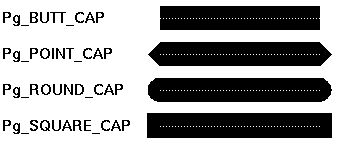
Styles for capping lines.
 |
The dotted lines in the above examples were added to illustrate how the caps relate to the original lines; they don't normally appear. |
PgSetStrokeCap() works on the current graphics context, while you can specify the graphics context gc for PgSetStrokeCapCx().
The previous cap value.
Photon
| Safety: | |
|---|---|
| Interrupt handler | No |
| Signal handler | No |
| Thread | No |
PgDefaultStroke*(), PgDrawEllipse*(), PgDrawLine*(), PgDrawPolygon*(), PgDrawRect*(), PgDrawRoundRect*(), PgSetDrawMode*(), PgSetStrokeDash*(), PgSetStrokeDither*(), PgSetStrokeJoin*(), PgSetStrokeTransPat*(), PgSetStrokeWidth*(), PgSetStrokeXORColor*(),
"Drawing attributes" and "Lines, pixels, and pixel arrays" in the Raw Drawing and Animation chapter of the Photon Programmer's Guide
|
|
|
|